| Brand Name: | ZMSH |
| MOQ: | 100 |
| Delivery Time: | 2-4 WEEKS |
| Payment Terms: | T/T |
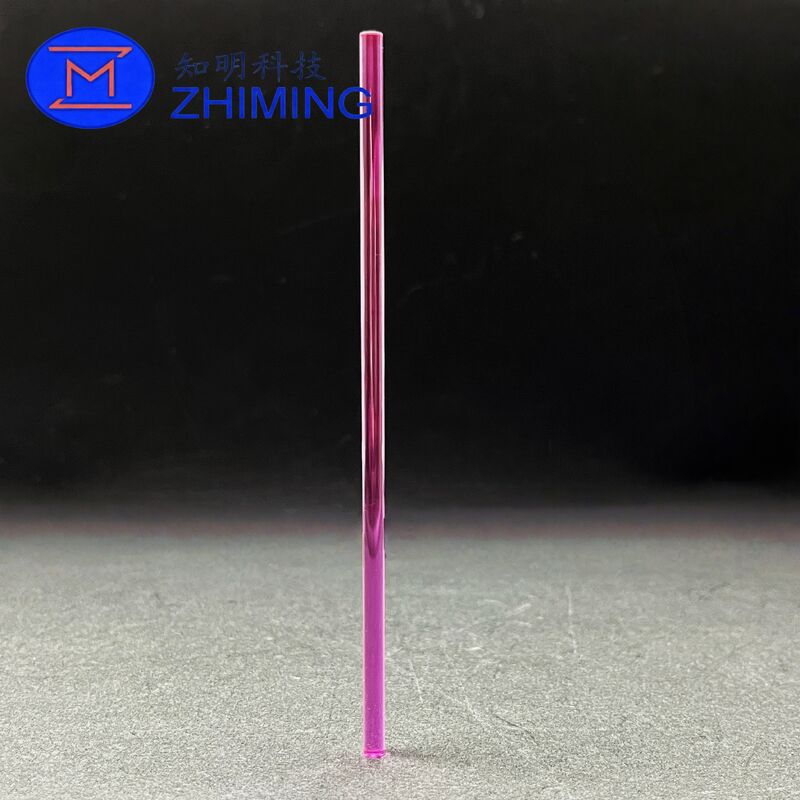
Synthetic Ruby Laser Rods (Cr:Al₂O₃) – High-Quality Solid-State Laser Rods
Synthetic ruby laser rods are precision-engineered cylindrical crystals made from high-purity aluminum oxide (Al₂O₃) doped with chromium ions (Cr³⁺). The chromium ions are responsible for laser activity, producing intense, coherent red light at a wavelength of 694.3 nm.
Manufactured using the Czochralski growth method, these ruby rods offer excellent optical quality, uniform chromium distribution, and minimal defects, ensuring consistent laser performance. With superior mechanical hardness, chemical inertness, and thermal conductivity, ruby rods are widely used in high-power Q-switched lasers, scientific research, medical procedures, holography, and educational demonstrations.
Available in customizable diameters (2–20 mm) and lengths (10–200 mm), these rods are polished to laser-grade standards and can be coated with AR or HR coatings for optimal performance in demanding laser systems.
![]()
![]()
High Optical Quality: Uniform chromium distribution with minimal defects for reliable laser performance.
Excellent Laser Performance: Produces coherent red laser light at 694.3 nm (R₁ line) with long fluorescence lifetime and high energy storage.
Durable and Hard: Mohs hardness 9, chemically inert, resistant to mechanical wear and corrosion.
Thermally Stable: High thermal conductivity reduces thermal lensing during high-power operation.
Versatile Pumping Compatibility: Suitable for xenon or krypton flashlamps; compatible with Q-switched, continuous-wave, or pulsed lasers.
Customizable Dimensions: Diameters from 2–20 mm and lengths from 10–200 mm, polished for precision optical setups.
Wide Applications: Ideal for scientific research, holography, medical lasers, material processing, and educational use.
| Property | Specification | Notes |
|---|---|---|
| Material Composition | Al₂O₃ doped with 0.03–0.05% Cr₂O₃ | Weight % substitution |
| Crystal Structure | Trigonal (α-Al₂O₃) | R3c space group |
| Laser Wavelength | 694.3 nm (R₁), 692.9 nm (R₂) | Primary and secondary emission lines |
| Diameter | 2–20 mm | Standard: 2mm/4mm |
| Length | 10–200 mm | Standard: 10mm/20mm |
| Refractive Index | 1.763 (ordinary ray) | At 694 nm |
| Absorption Coefficient | 0.4–1.2 cm⁻¹ | Depends on Cr³⁺ concentration |
| Thermal Conductivity | 12–46 W/(m·K) | 0–400°C |
| Thermal Expansion | 5 × 10⁻⁶ /K | Parallel to c-axis |
| Hardness | Mohs 9 | Very hard, durable |
| Density | 3.98 g/cm³ | — |
| Fluorescence Lifetime | 3 ms | 0.05% Cr³⁺ at 300K |
| Emission Cross-Section | 2.5 ×10⁻²⁰ cm² | R₁ line |
| Surface Finish | λ/10 at 633 nm | Laser-grade polish |
| Coatings | AR / HR optional | 694 nm |
| Damage Threshold | >500 MW/cm² | 10 ns pulses |
High-Power Q-Switched Lasers: Plasma diagnostics, material processing.
Holography: High-resolution holographic imaging.
Medical Procedures: Tattoo removal, dermatology, cosmetic treatments.
Scientific Research: Coherent light source for optical experiments.
Laser Material Processing: Drilling, cutting, precision machining.
Education: Demonstrations in laser physics and optics.
Rangefinding & Metrology: Precise distance measurement and optical instrumentation.
Q1: What is a ruby laser rod?
A: A ruby laser rod is a cylindrical crystal made from synthetic ruby (Al₂O₃ doped with Cr³⁺) used as a solid-state lasing medium to produce coherent red laser light.
Q2: How are ruby laser rods pumped?
A: They are optically pumped using high-intensity light sources such as xenon or krypton flashlamps. The energy excites chromium ions, which then emit coherent laser light.
Q3: How should ruby laser rods be stored?
A: Store in a dry, dark environment as Cr³⁺ ions are photosensitive. Avoid direct UV exposure and extreme temperature fluctuations.
Q4: How can I clean ruby rods?
A: Use methanol or other non-abrasive solvents. Avoid abrasive cleaners that can damage the polished surfaces.
Q5: Can ruby rods be customized?
A: Yes, diameters from 2–20 mm and lengths from 10–200 mm are available. Surface polish and coatings (AR/HR) can also be customized.
Q6: What are the main applications of ruby laser rods?
A: Applications include high-power Q-switched lasers, holography, medical procedures, material processing, scientific research, and education.
Environment: Keep in a dry, dark area to prevent photosensitivity damage.
Cleaning: Use methanol; avoid abrasive materials.
Mounting: Minimize mechanical stress; use soft indium foil for thermal contact.
Avoid: UV exposure, fingerprints on polished faces, or thermal cycling above 200°C.
Related Products