| Brand Name: | ZMSH |
| MOQ: | 20 |
| Delivery Time: | 4-9 WEEKS |
| Payment Terms: | T/T |
![]()
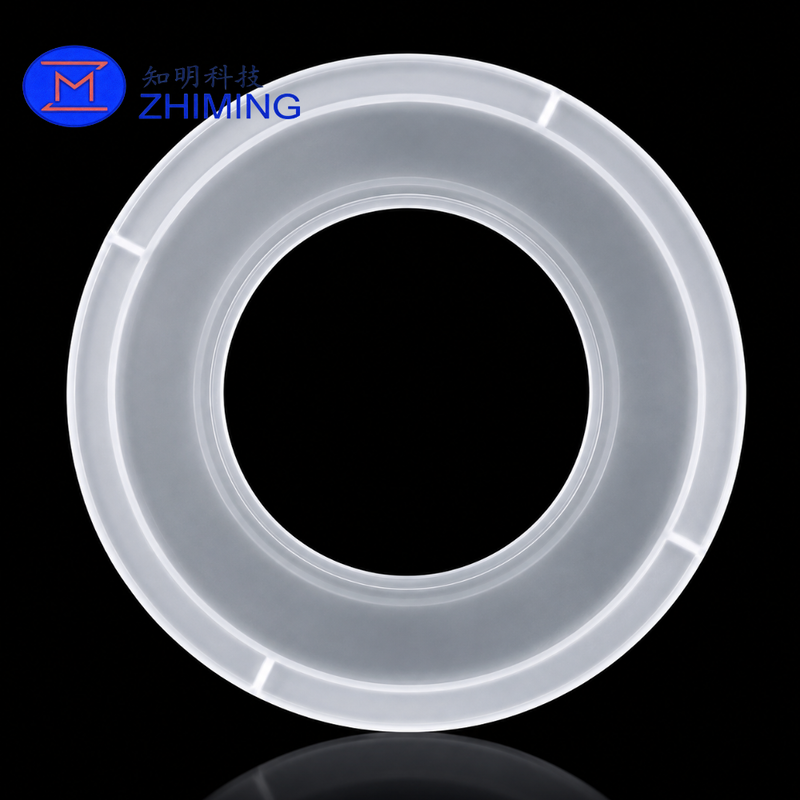
This high-purity fused quartz retaining ring is a large annular component manufactured for precision equipment assemblies that require thermal stability, electrical insulation, chemical resistance, and low material contamination. The product is characterized by a wide circular body, a large open center, a raised inner rim, a stepped outer profile, and multiple locating features distributed around the circumference.
Rather than being a simple flat quartz ring, the component contains several machined levels that can provide installation clearance, mechanical positioning, component separation, or controlled support within an equipment assembly. The broad annular surface offers a stable contact area, while the raised inner section can assist with centering another part or maintaining a defined gap around an internal process area.
The outer edge includes several machined interruptions or locating slots. These structures may be designed to match corresponding fixtures, prevent rotation, establish assembly orientation, or provide clearance for neighboring components. Their quantity, shape, position, depth, and width can be customized according to the customer’s technical drawing.
This quartz ring is suitable for custom semiconductor equipment, vacuum systems, high-temperature instruments, laboratory process chambers, optical assemblies, and other industrial systems where conventional metal or polymer rings may introduce contamination, electrical conductivity, or thermal-expansion concerns.
| Parameter | Specification |
|---|---|
| Product Name | Fused Quartz Retaining Ring |
| Material | High-Purity Fused Quartz / Fused Silica |
| Product Structure | Annular Ring with Stepped Profile |
| Shape | Large-Diameter Circular Ring |
| Outer Diameter | Custom, According to Drawing |
| Inner Diameter | Custom, According to Drawing |
| Overall Thickness | Custom, According to Drawing |
| Ring Width | Customizable |
| Step Height | Customizable |
| Step Width | Customizable |
| Locating Notches | Quantity, Size and Position Customizable |
| Surface Finish | Ground, Lapped, Frosted or Polished |
| Edge Treatment | Chamfered or Rounded Edges |
| Flatness | According to Customer Drawing |
| Parallelism | According to Customer Drawing |
| Concentricity | According to Customer Drawing |
| Quartz Grade | Industrial, High-Purity or Semiconductor Grade |
| Transparency | Transparent or Translucent, Depending on Finish |
| Processing Method | CNC Machining, Grinding, Lapping and Polishing |
| Cleaning | Standard Cleaning or High-Purity Cleaning |
| Packaging | Individual Protective Packaging |
| Application | Semiconductor, Vacuum and Thermal Equipment |
| Custom Manufacturing | Available Based on Drawing or Sample |
![]()
The product has a large circular opening through its center, creating a broad ring-shaped body. This open structure allows the ring to surround a process zone, chamber opening, tube, wafer area, heater, optical path, or other internal equipment component without blocking the central working area.
Its annular form can be adapted for several functions, including:
The exact role of the component depends on its installation position and the dimensions of the surrounding equipment. For this reason, the final product name may vary between quartz retaining ring, quartz support ring, quartz chamber ring, quartz spacer ring, or quartz flange ring.
A major feature of the component is its stepped cross section. The inner circumference includes a raised rim or shoulder, while the outer section contains additional changes in height and thickness.
This stepped construction may provide:
The inner raised rim can be supplied with a ground, polished, or fire-finished surface depending on whether it is used for positioning, contact, visual access, or particle control.
The transition between different levels can be produced with straight shoulders, radiused corners, bevels, or customized contours. Sharp internal corners are generally avoided where possible because carefully designed transitions can reduce local stress concentration in brittle quartz components.
![]()
Several evenly distributed features can be seen along the outer circumference. These may be shallow grooves, relief sections, alignment notches, or locating slots.
They can be used to:
The locating features are fully customizable. Customers may specify the number of slots, angular spacing, dimensions, corner radius, and relationship to other critical surfaces.
For replacement parts, it is important to verify the angular position of each locating feature. Even when the outer and inner diameters are correct, incorrectly positioned slots may prevent the component from fitting the original equipment.
The component can be produced from different grades of fused quartz or fused silica. Material selection should be based on the operating environment rather than appearance alone.
Available options may include:
High-purity quartz is commonly selected for equipment where metallic contamination, particle generation, and chemical compatibility must be controlled.
Synthetic fused silica may be considered when enhanced optical transmission or tighter control of material consistency is required. The appropriate material should be selected according to wavelength, temperature, atmosphere, purity, and equipment requirements.
Fused quartz has a low coefficient of thermal expansion and can maintain dimensional stability under many elevated-temperature conditions. This makes it useful for furnace assemblies, laboratory heating systems, semiconductor tools, and process chambers that experience repeated heating and cooling.
Its thermal performance still depends on several practical factors:
Uneven heating or rigid clamping can create thermal stress. Large-diameter rings should therefore be supported evenly and should not be forced into assemblies with insufficient clearance.
Quartz also offers resistance to many process chemicals and acids. However, it is not universally resistant to every chemical. Hydrofluoric acid and certain hot alkaline materials can attack quartz surfaces, so chemical compatibility must be reviewed before use.
Fused quartz is an electrically insulating material. The ring can therefore be used in equipment where electrical isolation is required between conductive components.
Potential applications include assemblies near:
The wide ring body may provide both mechanical separation and electrical isolation, depending on the final configuration.
The product shown has a semi-transparent or frosted annular surface combined with clearer polished edges. This mixed finish is often created intentionally according to the function of each area.
Available surface options include:
A ground surface provides a uniform matte appearance and is commonly used for non-optical support areas.
Lapping can improve flatness, parallelism, and contact consistency compared with ordinary grinding.
Polishing can increase transparency and create a smoother surface. It may be specified for visual inspection, optical transmission, reduced residue retention, or precise contact areas.
Fire polishing may smooth selected edges and reduce sharp machining marks. It is typically applied only where suitable for the required tolerance.
A controlled frosted finish may be used to reduce glare or provide a uniform non-optical surface.
Different finishes can be applied to the upper face, lower face, inner wall, outer wall, steps, and locating slots.
This fused quartz ring is made according to customer-specific dimensions. Available customization includes:
A complete drawing should clearly identify datum surfaces and critical dimensions. When concentricity and slot position are important, the drawing should include a defined reference axis.
Depending on the product dimensions and material blank, production may involve:
Large quartz components require careful handling throughout production because excessive local force can cause edge damage or hidden cracks.
For particularly demanding applications, a prototype can be produced first to confirm dimensional fit and installation compatibility.
The stepped fused quartz retaining ring can be considered for:
It may function as a support, retaining, alignment, separation, insulation, or protection component.
Because the exact use cannot be confirmed by appearance alone, operating conditions and assembly drawings should be reviewed before final manufacturing.
The complete ring geometry can be matched to existing equipment dimensions and assembly interfaces.
Fused quartz offers good dimensional stability during many heating and cooling processes.
High-purity grades help reduce the risk of contamination in sensitive process environments.
The component is manufactured as a single ring, avoiding joints between multiple assembled pieces.
Outer slots and stepped surfaces can help control orientation and installation position.
Ground, lapped, polished, frosted, and fire-finished surfaces can be combined in one component.
Prototype, replacement-part, and batch production requirements can be evaluated according to the drawing.
Inspection can be performed against the approved drawing. Common control items include:
Measurement methods should be agreed in advance when very tight tolerances are required, particularly for large rings where temperature and support conditions may influence measurement results.
Available cleaning and packaging services may include:
The product should be supported over a broad area during transport. Direct impact on the outer edge or inner opening should be avoided.
Please provide the following information for quotation:
For replacement equipment components, providing both the original drawing and several clear photographs can reduce the risk of dimensional misunderstanding.
A standard quartz flange is often associated with tube connections, sealing interfaces, or bolt-hole structures. This product has no visible bolt holes and is better described as a retaining, support, chamber, or positioning ring. It can still be placed under the Quartz Flange category because of its large stepped annular geometry.
Yes. Its diameter, height, width, corner radius, and surface finish can be changed according to the equipment drawing.
Holes, slots, relief areas, and positioning features can be evaluated. Feasibility depends on their dimensions, location, distance from the edge, ring thickness, and required strength.