| Brand Name: | ZMSH |
| Model Number: | Sic Tray |
| MOQ: | 25 |
| Price: | Fluctuates with market |
| Delivery Time: | 4-9 WEEKS |
| Payment Terms: | T/T |
Product Overview
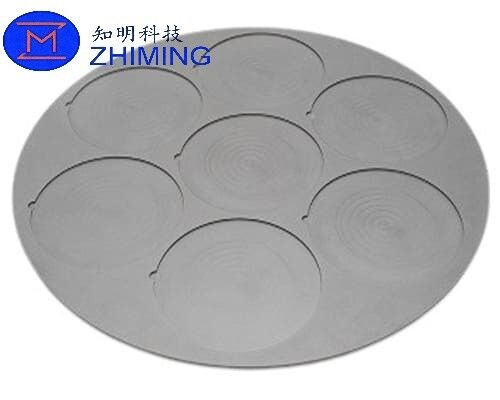
SiC Tray (Silicon Carbide Tray) is a high-performance high-temperature bearing component made of polycrystalline silicon carbide engineering ceramic, manufactured via advanced sintering processes including Reaction Bonded (RBSiC), Recrystallized (RSiC) and Silicon Nitride Bonded (N-SiC) technologies.
As an upgraded alternative to traditional alumina ceramic trays and fused quartz trays, it features outstanding high-temperature resistance, excellent thermal shock stability, uniform thermal conductivity and long service life. It is widely used as a carrier and setter plate in high-temperature sintering, annealing and heat treatment processes across semiconductor, electronic ceramic, new energy and industrial furnace industries. Custom shapes, structures and precision grades are available to match specific process requirements.
Core Technical Features
Customizable Structure & Precision
Supports round, square, rectangular and special-shaped profiles. Optional structures include flat plate, edge-raised, grooved, with positioning holes/grooves and multi-layer stepped types. Precision machining is available to meet high flatness requirements for semiconductor processes.
Standard Specifications
| Parameter | Specification Range |
|---|---|
| Material Grade | Reaction Bonded SiC (RBSiC); Recrystallized SiC (RSiC); Silicon Nitride Bonded SiC (N-SiC) |
| Shape | Round; Square; Rectangular; Custom Special Shape |
| Diameter (Round) | Ø50 mm – Ø500 mm (larger sizes customizable) |
| Size (Square/Rectangular) | 50×50 mm – 400×400 mm (larger sizes customizable) |
| Thickness | 3 mm – 30 mm |
| Flatness Tolerance | ±0.05 mm – ±0.2 mm (by precision grade) |
| Surface Finish | As-fired Matte; Fine Ground; Precision Polished |
| Max Continuous Working Temp | 1400℃ (RBSiC); 1650℃ (RSiC); 1550℃ (N-SiC) |
| Flexural Strength (Room Temp) | 250–450 MPa (by material grade) |
| Optional Structures | Flat Plate; Edge-raised; Grooved Surface; Positioning Holes/Grooves; Stackable Step |
![]()
Typical Applications
1.Semiconductor Manufacturing
Used as wafer carriers for silicon wafers, sapphire wafers and SiC substrates in high-temperature processes including annealing, oxidation, diffusion and low-pressure chemical vapor deposition (LPCVD), ensuring stable wafer positioning and uniform heating.
2.Electronic Ceramic Industry
Sintering carrier for MLCC (multi-layer ceramic capacitors), ceramic substrates, piezoelectric ceramics, ferrite magnetic materials and dielectric components, improving sintering consistency and reducing deformation of products.
3.New Energy & Lithium Battery
Heat treatment and sintering tray for lithium battery cathode/anode materials, solid electrolytes and photovoltaic cell materials, with excellent alkali corrosion resistance for N-SiC grade.
4.High-Temperature Industrial Furnaces
Used in powder metallurgy sintering, metal heat treatment, high-temperature material experiments and kiln lining components, replacing traditional alumina and mullite trays to extend service life significantly.
5.Photovoltaic Industry
Carrier for monocrystalline silicon wafers and solar cell slices during high-temperature diffusion, annealing and coating processes, supporting high-volume batch production.
Quality Control
A full-process quality management system is implemented from raw material inspection to finished product delivery, with strict inspection standards for each batch of products.
1.Raw Material Control:
High-purity silicon carbide powder is used, with incoming inspection of particle size, purity and composition to ensure material consistency.
2.Dimensional Inspection:
Full inspection of outer dimensions, thickness and flatness with high-precision measuring instruments to ensure compliance with tolerance requirements.
3.Appearance & Defect Screening:
100% visual inspection for cracks, edge chipping, pores and surface defects to guarantee intact appearance and structural integrity.
4.Material Performance Testing:
Regular sampling tests of density, flexural strength and high-temperature performance to verify material grade and reliability.![]()
5.Quality Documentation:
Each shipment is provided with a Certificate of Analysis (COA) covering key dimensional and performance indicators, and third-party test reports are available upon request.
FAQ
Q1: How do I choose the right SiC grade for my application?
A1: ①Choose RBSiC for cost-sensitive conventional sintering, mechanical wear scenarios and temperatures ≤1400℃
②Choose RSiC for high-temperature kilns above 1500℃, severe thermal cycling and long-life requirements
③Choose N-SiC for lithium battery materials, ceramic sintering with alkaline atmosphere and high strength demands
Q2: What flatness tolerance and surface finish can you achieve?
A2:①Standard as-fired grade: Flatness ±0.1 mm – ±0.2 mm, matte surface
②Precision machined grade: Flatness ±0.05 mm, fine ground surface
③High-precision semiconductor grade: Tighter flatness and polished surface available upon request
Q3: What is the maximum continuous working temperature of SiC trays?
A3: It depends on the material grade:
①RBSiC: 1400℃ long-term continuous use
②RSiC: Up to 1650℃ long-term, ideal for ultra-high temperature kilns
③N-SiC: Up to 1550℃ with excellent alkali corrosion resistance Short-term peak temperature can be slightly higher, but prolonged overheating will reduce service life.
Q4: Can SiC trays be stacked in the kiln? Will they deform under load?
A4: Yes, stackable designs are available. SiC ceramics have high flexural strength (250–450 MPa) and high temperature rigidity. With proper thickness design, they maintain dimensional stability under stacked loading at high temperature without sagging or deformation.
Q5: Do you accept sample orders? What is the MOQ?
A5: Yes, sample orders are available for standard size trays to verify performance. For standard products, low MOQ is supported. For custom sizes and special structures, MOQ depends on complexity, please contact our sales team for details.
Q6: What is the typical lead time for SiC trays?
A6: Standard stock items can be shipped within 3–7 working days. Custom machined standard sizes take 10–20 working days. Special custom shapes and large bulk orders require 20–35 working days, subject to order quantity and structure complexity.
Related Products
![]()