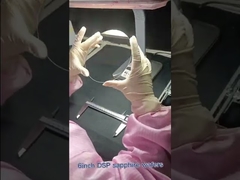
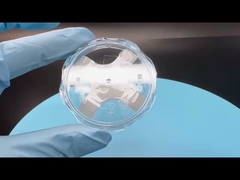
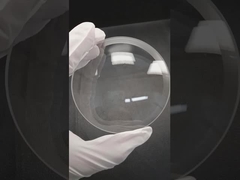
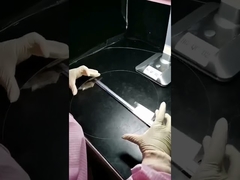
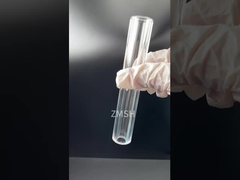
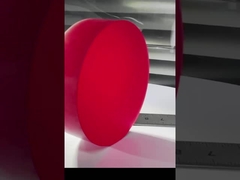
Brief: Wondering how this high-performance semiconductor material compares to other options? In this video, we provide a detailed walkthrough of the 2-inch Zn-doped Gallium Arsenide (GaAs) Wafer, showcasing its key characteristics and manufacturing process. You'll see how its VGF crystal growth method and zinc doping deliver stable p-type properties, making it ideal for LED, laser diode, and optoelectronic device fabrication. We'll also demonstrate the wafer's polished surfaces, orientation options, and quality controls that ensure reliable performance in both research and production environments.
Related Product Features:
Manufactured using the Vertical Gradient Freeze (VGF) crystal growth method for high-quality crystal structure.
Zinc doping provides stable and uniform p-type electrical characteristics for reliable device performance.
Features (100) crystal orientation with options for 2°, 6°, or 15° off (110) misorientation.
Offers controlled carrier concentration ranging from (0.3 - 1.0) × 10¹⁸ cm⁻³ for consistent electrical properties.
Provides low etch pit density of ≤ 5,000 cm⁻² and high Hall mobility of 1,500 - 3,000 cm²/V*s.
Includes polished surface finishes (P/P or P/E) with strict control of flatness, bow, and warp for advanced processing.
Supports optional orientation flats, notch configurations, and backside laser marking for flexible identification.
Suitable for direct use in MBE or MOCVD epitaxial growth processes with low particle contamination.
FAQs:
Is this GaAs wafer suitable for LED and laser diode manufacturing?
Yes. The Zn-doped p-type electrical characteristics, combined with (100) orientation and controlled carrier concentration, support stable light emission and consistent device performance in LED and laser diode manufacturing.
Can this wafer be used directly for epitaxial growth?
Yes. The wafer is supplied with polished surfaces, low particle contamination, and strict flatness control, allowing direct use in MBE or MOCVD epitaxial growth processes.
Can the wafer specifications be customized for different process requirements?
Yes. Options such as orientation flats, notch configuration, backside laser marking, surface finish, and selected electrical parameters can be adjusted upon request to meet specific equipment and process needs.