| Brand Name: | ZMSH |
| MOQ: | 10 |
| Delivery Time: | 2-4 weeks |
| Payment Terms: | T/T |
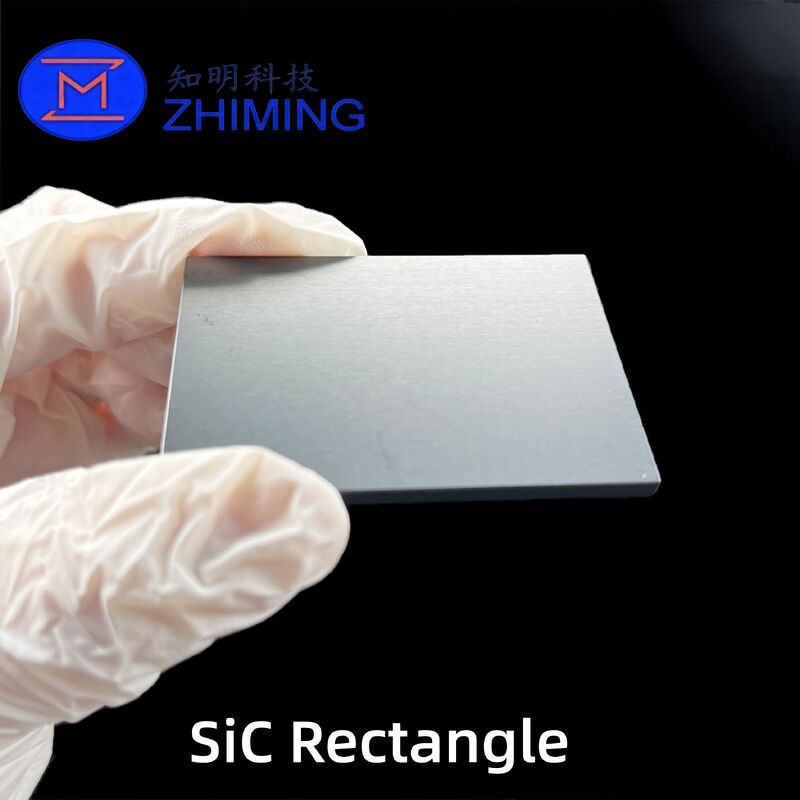
The Silicon Carbide (SiC) rectangle substrate is an advanced single-crystal semiconductor material designed to meet the stringent requirements of modern power electronics, optoelectronic devices, and high-frequency applications. SiC is recognized for its excellent thermal conductivity, wide electronic bandgap, and exceptional mechanical strength, which makes it ideal for use in extreme environments, such as high temperatures, high voltage, and high switching frequencies. This SiC substrate is commonly used in R&D labs, prototype development, and manufacturing specialized devices.
![]()
![]()
Manufacturing Process of Silicon Carbide (SiC) Substrate Chips
The production of Silicon Carbide (SiC) substrates involves advanced crystal growth techniques such as Physical Vapor Transport (PVT) or sublimation. The process includes:
Raw Material Preparation: Ultra-pure SiC powder is placed into a high-density graphite crucible for sublimation.
Crystal Growth: At temperatures exceeding 2,000°C, the SiC material sublimates and recondenses onto a seed crystal to form a large single-crystal SiC boule.
Ingot Slicing: Diamond wire saws are used to slice the boule into thin wafers or chips in rectangular shapes.
Lapping & Grinding: Surface planarization ensures uniform thickness and removes slicing marks.
Chemical Mechanical Polishing (CMP): The substrate is polished to a mirror-smooth finish, suitable for epitaxial layer deposition.
Optional Doping: N-type or P-type doping is available to adjust electrical properties as per the application needs.
Quality Assurance: Rigorous testing of flatness, defect density, and thickness guarantees compliance with semiconductor standards.
![]()
![]()
Material Properties of Silicon Carbide (SiC)
SiC is primarily available in 4H-SiC and 6H-SiC crystal structures, each optimized for specific applications:
4H-SiC: Provides higher electron mobility and is ideal for high-voltage power electronics such as MOSFETs and Schottky diodes.
6H-SiC: Ideal for RF and microwave applications, offering lower power loss in high-frequency operations.
Key advantages of SiC substrates include:
Wide Bandgap: Approximately 3.2–3.3 eV, offering high breakdown voltage and efficiency in power devices.
Thermal Conductivity: 3.0–4.9 W/cm·K, ensuring excellent heat dissipation in power applications.
Mechanical Strength: Mohs hardness of ~9.2, making SiC highly resistant to wear and tear.
Applications of Silicon Carbide (SiC) Rectangle Substrate Chips
Power Electronics: Ideal for MOSFETs, IGBTs, and Schottky diodes used in electric vehicle powertrains, energy storage systems, and power conversion.
High-Frequency & RF Devices: Perfect for radar systems, satellite communications, and 5G base stations.
Optoelectronics: Suitable for UV LEDs, laser diodes, and photodetectors due to excellent UV transparency.
Aerospace & Defense: Enables operation in radiation-prone and high-temperature environments.
Academic & Industrial Research: Excellent for developing new materials, prototypes, and devices.
Technical Specifications:
| Property | Value |
|---|---|
| Dimensions | Custom rectangular sizes available |
| Thickness | 330–500 μm (customizable) |
| Polytype | 4H-SiC or 6H-SiC |
| Orientation | C-plane, off-axis (0°/4°) |
| Surface Finish | Single/double-side polished, epi-ready |
| Doping Options | N-type, P-type |
| Quality Grade | Research or device-grade |
Customization Options:
Custom Dimensions: Available in a variety of sizes and shapes, including custom rectangular formats.
Doping Profiles: N-type or P-type doping available for tailored electrical performance.
Surface Treatments: Single-side or double-side polishing, as well as custom epitaxial layers.
Packaging & Delivery:
Packaging: Custom packaging solutions to ensure safe delivery.
Delivery Time: Typically within 30 days after order confirmation.
FAQ – Silicon Carbide (SiC) Rectangle Substrate Chips
Q1: Why choose SiC substrates over traditional silicon?
SiC offers superior thermal performance, higher breakdown strength, and significantly lower switching losses compared to silicon, making it ideal for high-efficiency, high-power applications.
Q2: Can these substrates be provided with epitaxial layers?
Yes, we offer epi-ready and custom epitaxy options for high-power, RF, or optoelectronic device applications.
Q3: Can you customize the dimensions and doping?
Absolutely. Custom sizes, doping profiles, and surface treatments are available to meet specific application needs.
Q4: How do SiC substrates perform under extreme conditions?
SiC substrates maintain structural integrity and electrical stability at temperatures over 600°C, making them suitable for harsh environments such as aerospace, defense, and high-power industrial applications.
Related Products